How New Orleans Soil Type Affects Your Lawn Health and What to Do About It
New Orleans sits on some of the most challenging soil in the country for lawn care. The city’s heavy clay and alluvial soils drain poorly, compact easily, become waterlogged after rain, and turn rock-hard when dry. Understanding how your specific soil type behaves is the first step to building a lawn care program that actually works in Louisiana, because the standard advice written for Midwest or Pacific Northwest lawns simply does not apply here.
Most lawn care problems in New Orleans, including patchy turf, persistent standing water, weeds that keep coming back, and fertilizer that never seems to work, trace back to the same root cause: soil that is not suited to supporting healthy turf without active management.
This guide explains what type of soil most New Orleans properties have, how it affects your lawn, and the specific steps you can take to improve it so your grass thrives rather than struggles.
What Type of Soil Does New Orleans Have?
New Orleans and surrounding parishes sit on a river delta, which is land built up over thousands of years by Mississippi River sediment deposits. This geology creates soil dominated by very fine particles: clay and silt.
According to the USDA Natural Resources Conservation Service, the dominant soil types in Orleans Parish and surrounding communities include Harahan clay, Commerce silt loam, and Norwood silt loam. All of these share a high fine-particle content and a low natural drainage rate.
Clay Soil: The Primary Challenge
Clay soil is composed of extremely small, plate-like particles that pack tightly together. This creates a dense structure with tiny pore spaces that restrict both water movement and air circulation. The practical effects on your lawn are significant:
- Water moves through clay soil very slowly, causing puddles and saturated zones after rain.
- Roots struggle to penetrate compacted clay, keeping the root system shallow and reducing drought tolerance.
- When clay dries out, it shrinks and hardens into a nearly impenetrable surface, causing extreme moisture swings between wet and dry periods.
- Nutrient availability decreases in compacted clay because fertilizer cannot reach the root zone effectively.
These characteristics explain why many New Orleans homeowners experience standing water after rain, dry cracks in summer, and grass that looks stressed even with consistent watering and fertilization.
Alluvial Soil Variability
River delta soils are also notoriously variable. Properties within the same block can have dramatically different soil compositions depending on how sediment was deposited historically. One yard may have relatively well-draining sandy loam while a neighboring property has dense clay just 6 inches below the surface.
This variability means that general soil advice is often unreliable for New Orleans homeowners. A basic soil test is the most reliable starting point for understanding what you are actually working with.
How New Orleans Soil Directly Affects Your Lawn
Poor Drainage Creates Root Problems
When water sits in the root zone for extended periods, grass roots are deprived of oxygen. Most turfgrasses can tolerate saturated soil for 24 to 48 hours before root damage begins. New Orleans regularly receives rainfall events of 2 to 4 inches in a single day, and clay soil may take 48 to 72 hours to drain adequately.
Chronic poor drainage leads to shallow root systems, making your lawn more susceptible to drought stress during dry periods. This creates a cycle where the same lawn that floods in May struggles in August.
Soil Compaction Limits Nutrient Uptake
High foot traffic, vehicle parking on lawns, and the natural settling of clay soil over time creates compaction that restricts the movement of water, air, and nutrients through the soil profile. In compacted soil, fertilizer applied at the surface often cannot reach the root zone effectively.
Lawn aeration, which is the process of mechanically removing small plugs of soil to create channels for water, air, and nutrients, is one of the most effective tools for improving compacted clay soil. Big Easy Grass Cutting’s lawn aeration service is specifically designed to address the compaction challenges common in South Louisiana.
Soil pH Affects Nutrient Availability
New Orleans soil tends toward slightly acidic to neutral pH, typically ranging from 5.5 to 7.0. Most warm-season grasses prefer a pH between 6.0 and 7.0. When soil pH falls below 6.0, essential nutrients like phosphorus, potassium, and calcium become less available to grass roots even when they are present in the soil. This condition is called nutrient lockout.
The LSU AgCenter recommends testing soil pH every two to three years and applying lime to raise pH if it drops below 6.0. For lawns struggling despite adequate fertilization, an off-target pH is often the hidden culprit.
How to Improve New Orleans Soil for a Healthier Lawn
Step 1: Test Your Soil Before You Do Anything Else
A basic soil test from the LSU AgCenter or a private lab costs $15 to $30 and tells you your soil pH, nutrient levels, and organic matter content. This information shows you exactly what your soil is missing and prevents you from spending money on amendments you do not need.
Step 2: Aerate Annually to Combat Compaction
Core aeration should be performed once per year on most New Orleans lawns, ideally in late spring or early summer when warm-season grasses are actively growing and can recover quickly. Aeration removes plugs of soil 2 to 3 inches deep, creating channels that allow water and air to reach roots more effectively.
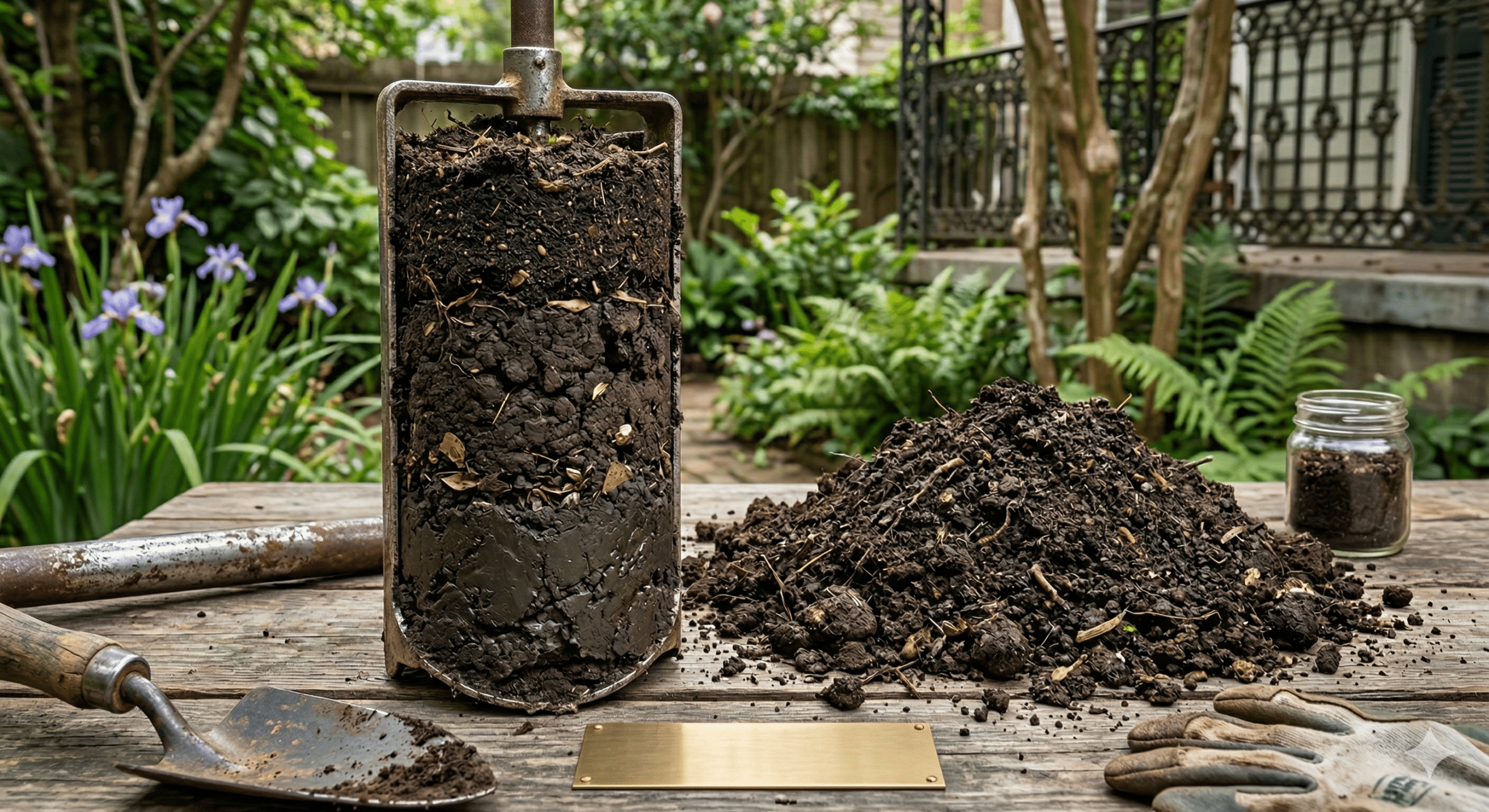
Lawns with heavy clay composition or high foot traffic may benefit from twice-yearly aeration. Many professionals recommend pairing aeration with topdressing, which means spreading a thin layer of compost or quality topsoil over the lawn surface to gradually improve the soil profile.
Step 3: Add Organic Matter to Improve Soil Structure
The single best long-term fix for clay-dominated New Orleans soil is adding organic matter consistently over several years. Organic matter creates pore spaces in compacted clay, improves drainage, feeds soil microbes, and releases nutrients slowly as it decomposes.
Practical ways to add organic matter include topdressing with compost after each aeration, mulching grass clippings rather than bagging them, and mulching leaves in fall. Over three to five years of consistent practice, you will see measurable improvement in drainage and turf density.
Step 4: Improve Drainage in Chronically Wet Zones
Some parts of New Orleans properties simply do not drain well because of grade, meaning the land is flat or slopes toward the house rather than away from it. Options include installing French drains or a surface drainage channel, regrading low spots to direct water flow away from the lawn, or planting water-tolerant ground covers in areas where turf consistently fails.
Which Grass Types Handle New Orleans Soil Best?
- St. Augustine grass is the most popular choice and tolerates clay soil and partial waterlogging better than most alternatives. Its vigorous lateral growth helps it recover from compaction-related stress.
- Centipede grass actually prefers low-fertility, acidic soil, which makes it a surprisingly good fit for some New Orleans properties. It requires less fertilizer than St. Augustine.
- Bermuda grass tolerates clay but requires excellent drainage to thrive. It struggles in the chronically wet zones common in New Orleans’ lower-lying neighborhoods.
- Zoysia grass has a dense growth habit that provides some resistance to compaction, but it is less tolerant of standing water than St. Augustine.
When Should You Call a Professional?
- Your lawn has persistent standing water after rain that drains in more than 48 hours. This indicates a drainage problem that soil amendment alone will not solve.
- Your soil has never been tested and your lawn struggles despite regular fertilization and watering. A soil test followed by professional lawn fertilization calibrated to your results is the most efficient path forward.
- You notice areas where grass will not grow despite reseeding or patching. These dead zones often indicate extreme compaction or a localized drainage problem that requires aeration or grade correction.
Big Easy Grass Cutting serves homeowners across New Orleans, Metairie, Kenner, Gretna, and the surrounding metro area with lawn care services designed for local conditions.
Frequently Asked Questions
What type of soil is in New Orleans?
New Orleans sits on Mississippi River delta soil, which is predominantly heavy clay and silt loam. These soils are dense, drain slowly, compact easily, and present specific lawn care challenges including poor root penetration, waterlogging after rain, and nutrient availability problems.
How do I fix clay soil in my New Orleans lawn?
The most effective approach combines annual core aeration, consistent topdressing with compost, mulching clippings and leaves, and soil pH correction based on a test. Improvement is gradual. Plan on three to five years of consistent effort to see significant changes in soil structure and drainage.
How do I know if my lawn has a drainage problem?
If water stands on your lawn for more than 24 to 48 hours after a normal rain event, you have a drainage issue. Other signs include grass that is consistently thinner in specific zones, moss or algae growth on soil, and recurring fungal disease in the same areas each year.
Does aerating help clay soil in New Orleans?
Yes. Core aeration is one of the most effective tools for improving clay soil because it physically creates channels for water and air to penetrate. Results are most visible when aeration is combined with topdressing compost into the aeration holes immediately after the process.
Should I add sand to my clay lawn soil?
Adding sand to clay soil is generally not recommended unless done in very large quantities with proper mixing. Adding small amounts of sand to clay actually creates a compound that is harder than clay alone. Compost is a far more effective amendment.
How much does lawn aeration cost in New Orleans?
Professional lawn aeration in New Orleans typically costs between $75 and $200 depending on lawn size. When paired with overseeding or topdressing, the combined service provides excellent return on investment for homeowners dealing with compacted or clay-heavy soil.
What pH should my New Orleans lawn soil be?
Most warm-season grasses grown in New Orleans, including St. Augustine, Bermuda, Centipede, and Zoysia, perform best at a soil pH between 6.0 and 7.0. Below 6.0, nutrient availability decreases significantly. Have your soil tested every two to three years and apply dolomitic lime if your pH is below 6.0.
Can I grow a healthy lawn in New Orleans despite the soil challenges?
Yes. Thousands of New Orleans homeowners maintain beautiful, healthy lawns in Louisiana’s challenging soil conditions. The key is selecting the right grass variety, understanding your specific soil through testing, and following a care program designed for local conditions rather than generic national advice.
Get a Lawn Care Plan Built for New Orleans Soil
Big Easy Grass Cutting’s team has extensive experience with the clay, silt, and alluvial soils common throughout Orleans Parish and surrounding communities. We build lawn care programs designed to work with local conditions, not against them.
Whether you need aeration, fertilization calibrated to local soil, or a full lawn assessment, we are here to help.
Call 504-910-7829 or request a free estimate online to schedule your evaluation.
{ "@context": "https://schema.org", "@type": "Article", "headline": "How New Orleans Soil Type Affects Your Lawn Health and What to Do About It", "description": "New Orleans clay-heavy soil causes drainage and nutrient problems. Learn how to identify your soil type and improve it for a healthier lawn.", "url": "https://www.bigeasygrasscutting.com/how-soil-type-new-orleans-affects-lawn-health/", "author": { "@type": "Organization", "name": "Big Easy Grass Cutting", "url": "https://www.bigeasygrasscutting.com" }, "publisher": { "@type": "Organization", "name": "Big Easy Grass Cutting", "logo": { "@type": "ImageObject", "url": "https://www.bigeasygrasscutting.com/wp-content/uploads/2023/07/logo.png" } }, "mainEntity": { "@type": "FAQPage", "mainEntity": [ { "@type": "Question", "name": "What type of soil is in New Orleans?", "acceptedAnswer": { "@type": "Answer", "text": "New Orleans sits on Mississippi River delta soil, predominantly heavy clay and silt loam that drains slowly, compacts easily, and presents specific lawn care challenges including poor root penetration and nutrient availability problems." } }, { "@type": "Question", "name": "Should I add sand to my clay lawn soil?", "acceptedAnswer": { "@type": "Answer", "text": "Adding small amounts of sand to clay soil is not recommended. It can create a compound that is harder than clay alone. Compost is a far more effective amendment for improving clay soil structure." } }, { "@type": "Question", "name": "How much does lawn aeration cost in New Orleans?", "acceptedAnswer": { "@type": "Answer", "text": "Professional lawn aeration in New Orleans typically costs between $75 and $200 depending on lawn size." } } ] } }