Can Over-Fertilizing Damage Your Grass? Yes, and Here Is What to Do
Yes, over-fertilizing can seriously damage your grass. Applying too much fertilizer causes fertilizer burn, which draws moisture out of grass roots and turns your lawn yellow or brown within days. The good news is that most lawns recover fully within two to four weeks if you catch it early and flush the soil with water. Knowing the signs and how to act fast is the key to saving your turf.
Fertilizing your lawn is one of the best things you can do for it, but more is not always better. In New Orleans and the greater South Louisiana area, where heat and humidity already stress warm-season grasses, applying too much fertilizer at the wrong time can turn a lush lawn into a patchy, burnt-looking mess almost overnight.
This guide walks you through exactly what over-fertilizing looks like, why it happens, how to fix it, and how to fertilize correctly so your lawn stays healthy all season long.
What Does Over-Fertilizing Actually Do to Your Grass?
When you apply more fertilizer than your soil can absorb, the excess salts in the product build up around the roots. This process, called salt toxicity or fertilizer burn, pulls moisture out of the grass through osmosis and essentially dehydrates the plant from the roots up.
Think of it like pouring salt on a slug. The same chemistry that kills weeds on a sidewalk can happen to your grass when fertilizer concentrations get too high. The result is visually dramatic and happens fast, often within 24 to 72 hours of over-application.
The three main culprits behind fertilizer burn are applying too much product, applying in hot or dry conditions, and using fast-release nitrogen formulas on already-stressed grass.
Signs Your Lawn Has Fertilizer Burn
Before you can fix the problem, you need to confirm fertilizer burn is what you are dealing with. Here are the most common signs:
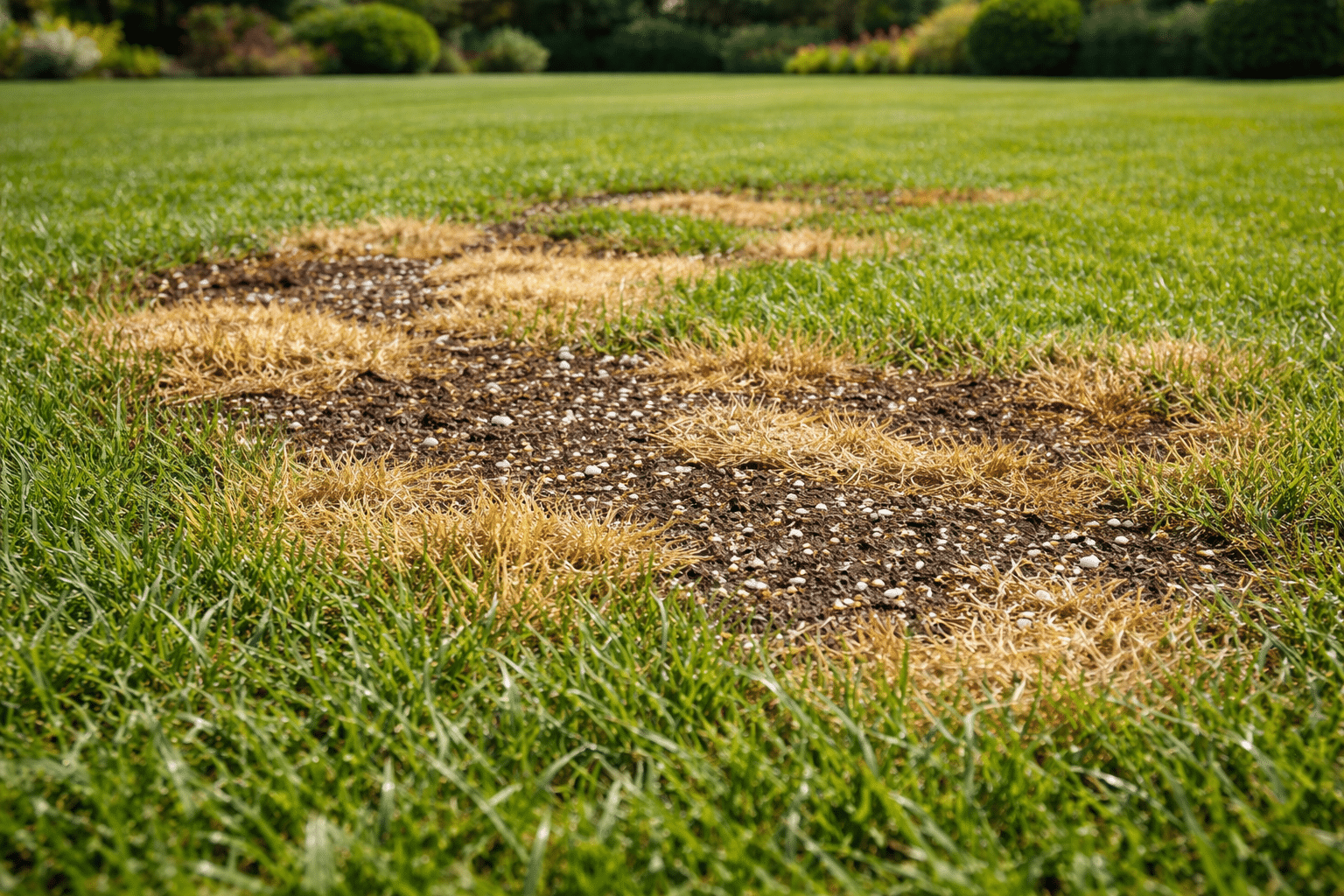
- Yellow or brown streaks that appear in lines or patterns matching how you applied the fertilizer. This stripe pattern is the clearest indicator of burn rather than disease or drought.
- Crispy, dried-out blades that feel stiff to the touch even after watering.
- Rapid color change that happens within a few days of fertilizing, rather than the gradual yellowing associated with nutrient deficiency.
- White salt crust on the soil surface visible in heavily over-fertilized patches.
- Healthy grass immediately surrounding the damaged zone. Pest damage and disease usually spread more evenly across the lawn.
If you see these signs within 72 hours of fertilizing, fertilizer burn is almost certainly the cause. Act quickly because the sooner you flush the soil, the better the recovery.
How to Fix Fertilizer Burn: Step by Step
Step 1: Water the Area Deeply and Immediately
As soon as you suspect fertilizer burn, water the affected area deeply. You are trying to dilute the salt concentration in the soil and push it below the root zone. Apply about 1 inch of water per day for at least four to seven consecutive days. Use a rain gauge or a small container to measure output accurately.
Do not wait to see if the grass recovers on its own. Every hour the salt concentration stays high, more root damage occurs.
Step 2: Remove Excess Granules If Still Visible
If you over-applied a granular fertilizer and can still see pellets on the soil surface, gently rake them up before watering. Removing visible granules before they dissolve reduces the total salt load you need to flush out.
Step 3: Test Your Soil After Flushing
After one week of deep watering, consider a basic soil test to check salt and nutrient levels. The LSU AgCenter offers soil testing resources specific to Louisiana lawns. A test confirms whether salt levels are back to normal before you refertilize.
Step 4: Wait Before Reseeding or Refertilizing
Give the lawn at least two to four weeks to recover before applying any new fertilizer. If patches of grass died completely and did not green up after flushing, you may need to reseed or lay new sod. In New Orleans, St. Augustine grass plugs are often the fastest way to fill in dead patches.
How Much Fertilizer Is Too Much?
The safe application rate depends on the fertilizer’s nitrogen content and your grass type. For the most common Louisiana lawn grasses:
- St. Augustine grass: No more than 1 pound of actual nitrogen per 1,000 square feet per application, with at least six weeks between applications during the growing season.
- Bermuda grass: Up to 1.5 pounds of nitrogen per 1,000 square feet, but only during active growth from April through August.
- Centipede grass: The most sensitive option. Limit nitrogen to 0.5 pounds per 1,000 square feet per application and fertilize no more than twice per year.
- Zoysia grass: 0.5 to 1 pound of nitrogen per 1,000 square feet, once every six to eight weeks in the growing season.
To calculate actual nitrogen content, multiply the bag weight by the nitrogen percentage listed first on the fertilizer label. A 50-pound bag of 10-0-5 fertilizer contains 5 pounds of actual nitrogen (50 x 0.10 = 5). Always measure your lawn area before calculating how much product to use.
Why Over-Fertilizing Is a Bigger Risk in New Orleans
South Louisiana’s climate makes fertilizer burn more likely than in cooler, drier regions. Heat accelerates how fast nitrogen salts interact with soil and roots. When temperatures stay above 90 degrees Fahrenheit from June through September in New Orleans, fertilizer absorption slows while burn risk increases dramatically.
Heavy summer rainfall can also wash surface-applied fertilizer into concentrated pools in low spots, creating localized burn zones even when the overall application rate was correct.
The best strategy for Louisiana homeowners is to fertilize during the cooler parts of the growing season, specifically late March through May and again in September, rather than during peak summer heat. Use slow-release fertilizer formulas whenever possible because they release nitrogen gradually and significantly reduce burn risk.
When Should You Call a Professional?
Most fertilizer burn cases are manageable with the steps above. Professional help is the right call in these situations:
- Large-scale damage covering more than 30 percent of your lawn. At this scale, recovery without professional assessment is unpredictable, and you risk over or under-watering the wrong zones.
- Damage that does not improve after two weeks of deep watering. Persistent brown patches may indicate root death or a secondary fungal infection triggered by the stressed turf.
- You are unsure whether the damage is fertilizer burn or a pest or disease issue. Chinch bug damage and brown patch fungus can look similar to fertilizer burn. Treating the wrong problem makes things worse.
- You want to prevent it from happening again. A professional lawn fertilization service calibrates application rates precisely for your lawn size, grass type, and current soil conditions.
Big Easy Grass Cutting provides professional lawn fertilization services throughout New Orleans, Metairie, Kenner, and surrounding communities, with application rates calibrated to your specific grass type and Louisiana’s seasonal conditions.
Ready for a Lawn That Stays Green All Season?
Over-fertilizing is one of the most common and most preventable lawn care mistakes in New Orleans. If your lawn is showing signs of fertilizer burn, or if you want to make sure your next application is done right, Big Easy Grass Cutting is here to help.
Call us at 504-910-7829 or request a free estimate online to schedule professional lawn fertilization service in New Orleans, Metairie, Kenner, Gretna, and the surrounding Greater New Orleans area.
Explore our full range of lawn care services, including weed control and lawn aeration, to keep your yard looking its best year-round.
Frequently Asked Questions
Can grass recover from over-fertilizing?
Yes, most grass can recover from fertilizer burn if you act quickly. Flush the soil with deep watering for four to seven consecutive days within the first 48 to 72 hours of noticing damage. Grass that still has living root tissue will begin to green up within two weeks. Completely dead patches may need to be resodded or reseeded.
How long does it take for fertilizer burn to go away?
With immediate flushing, you should see recovery beginning within 10 to 14 days. Full recovery, including even color and uniform density, typically takes three to four weeks depending on the severity of the burn and the health of the underlying root system.
What type of fertilizer is least likely to burn grass?
Slow-release or controlled-release nitrogen fertilizers are the safest option for most lawns. These products release nitrogen gradually over six to twelve weeks, reducing the salt spike that causes burn. Organic fertilizers such as compost-based or feather meal products are even gentler, though they release nutrients more slowly.
Can too much fertilizer kill grass permanently?
Yes, severe over-fertilization can permanently destroy the root system. This is most likely when extremely high rates are applied during hot, dry conditions. Roots that are fully killed will not regenerate and those areas require new sod or seed. That is why fast action with deep watering is so critical.
Is it safe to water right after fertilizing?
Yes. For granular fertilizers, a light watering immediately after application helps activate the product and reduces burn risk by preventing granules from sitting dry on the blades. About a quarter inch of water is enough. For liquid fertilizers, water lightly if rain is not expected within 24 hours.
How much does lawn fertilization cost in New Orleans?
Professional lawn fertilization in New Orleans typically costs between $50 and $150 per application, depending on lawn size and the product used. Annual programs covering three to four applications often run $150 to $400 per year. Getting the rate right with professional application is far less expensive than repairing burn damage or replacing sod.
Can I fertilize my lawn in summer in Louisiana?
You can, but the burn risk is higher. If you fertilize in summer, use only slow-release formulas, apply in the early morning, and water deeply immediately after. Avoid fertilizing when temperatures are above 90 degrees Fahrenheit or during drought conditions. Many Louisiana lawn care professionals recommend skipping midsummer fertilization and focusing on spring and early fall applications instead.
What is the difference between fertilizer burn and drought stress?
Both cause yellowing or browning, but the patterns differ. Fertilizer burn appears in streaks or zones that match where you applied the product and happens within days of application. Drought stress is more uniform across the lawn, develops gradually over weeks, and is preceded by visible wilting. Timing and pattern are your best diagnostic clues.
{ "@context": "https://schema.org", "@type": "Article", "headline": "Can Over-Fertilizing Damage Your Grass? Yes, and Here Is What to Do", "description": "Over-fertilizing can burn and kill your grass. Learn the signs, causes, and how to fix fertilizer burn fast.", "url": "https://www.bigeasygrasscutting.com/can-over-fertilizing-damage-your-grass/", "author": { "@type": "Organization", "name": "Big Easy Grass Cutting", "url": "https://www.bigeasygrasscutting.com" }, "publisher": { "@type": "Organization", "name": "Big Easy Grass Cutting", "logo": { "@type": "ImageObject", "url": "https://www.bigeasygrasscutting.com/wp-content/uploads/2023/07/logo.png" } }, "mainEntity": { "@type": "FAQPage", "mainEntity": [ { "@type": "Question", "name": "Can grass recover from over-fertilizing?", "acceptedAnswer": { "@type": "Answer", "text": "Yes, most grass can recover from fertilizer burn if you flush the soil with deep watering for four to seven consecutive days within 48 to 72 hours of noticing damage. Completely dead patches may need reseeding or new sod." } }, { "@type": "Question", "name": "How long does it take for fertilizer burn to go away?", "acceptedAnswer": { "@type": "Answer", "text": "With immediate flushing, recovery typically begins within 10 to 14 days. Full recovery takes three to four weeks depending on how severe the burn was." } }, { "@type": "Question", "name": "How much does lawn fertilization cost in New Orleans?", "acceptedAnswer": { "@type": "Answer", "text": "Professional lawn fertilization in New Orleans typically costs between $50 and $150 per application depending on lawn size and the product used." } } ] } }