


Covington sits on the Northshore of Lake Pontchartrain, in a part of St. Tammany Parish that grew up among pine forests and now protects a prized live oak canopy. That shade, acidic soil, and a slow-growing grass that punishes overfeeding are why lawns here fail differently than lawns across the lake.
When a centipede lawn under tall trees starts thinning and turning yellow, the reflex fix of more fertilizer tends to make it worse.
Lawn care in Covington follows different rules than it does on the south shore. Centipede is common here, tree cover shapes nearly every yard, and the soil chemistry pushes back against habits that suit a sunny St. Augustine lawn.
At Big Easy Grass Cutting, we care for lawns across the Northshore, and we put this guide together for Covington homeowners who want grass that holds up under their trees.
If your grass is thinning, yellowing, or refusing to fill in under your trees, contact us and we can take a look before the next growing season.
Below, we break down what makes this area different, what causes centipede grass to struggle, which warning signs matter, and how each problem is treated.
What Makes Lawn Care in Covington Different
Covington has been the seat of St. Tammany Parish since 1829, according to the City of Covington’s history page. The same page notes that the area’s early trails ran through vast virgin pine forests, and that south shore visitors once came here to escape the city’s heat. Trees still define the town, and they shape nearly every lawn decision you make.
Pine and Live Oak Shade
The city’s Tree Board lists care of Covington’s live oak canopy as a special interest. That canopy is beautiful, and it is hard on grass.
The LSU AgCenter notes that trees with spreading branches, such as live oaks, can create extremely shady conditions. Grass growing under a tree gets filtered light, so it grows taller but not denser. Trees and turf also compete for the same soil moisture.
Centipede Grass Country
In her guide to taking care of centipedegrass lawns, Mary Helen Ferguson, an LSU AgCenter extension agent serving Tangipahoa and Washington parishes next door, calls centipede and St. Augustine the two most common turfgrasses in her area. She adds that best practices for the two are different, and care meant for one will not give the best results on the other.
Centipede earned the nickname “lazy man’s grass” because it grows slowly and needs little upkeep. It also tolerates only light shade, while St. Augustine is considered the most shade-tolerant warm-season grass.
Acidic, Heavy Soil
The soil in Covington is mostly clay, and it can be challenging to work with. Ferguson notes that many soils in the Southeast are naturally acidic, and centipede actually prefers that. The LSU AgCenter’s home lawn guide to centipedegrass recommends a soil pH between 5 and 6 for this grass, which is more acidic than most other turfgrasses want.
Plenty of Rain, Uneven Timing
NOAA’s 1991 to 2020 climate normals for the Covington 4 NNW weather station show about 62.5 inches of rain a year. June is the wettest month at roughly 6.7 inches, and November is the driest at about 4 inches. Averages hide the dry stretches between storms, though, and those gaps matter for a grass that dislikes drought.
Common Causes of Thin or Yellow Centipede Grass
LSU AgCenter guidance points to four causes, and they often overlap.
Too Much Fertilizer and Phosphorus
In the LSU AgCenter article Pitfalls of Lazy Man’s Grass, horticulturist Dr. Tom Koske warns that owners can “kill it with kindness.” Centipede needs very little nitrogen, and heavy feeding is linked to excess thatch, iron chlorosis, and a lethal pattern called centipedegrass decline.
Phosphorus is a separate trap. According to LSU, repeated use of all-purpose blends like 8-8-8 and 13-13-13 can build up too much phosphorus and harm centipede lawns. For any nutrient other than nitrogen, Ferguson says a soil test is the only way to know how much, if any, the lawn needs.
Soil pH Drifting Too High
Many Louisiana soils hold enough iron, but that iron becomes unavailable to plants when pH climbs. LSU warns that centipede leaves can yellow when soil goes above pH 7, and that very high phosphorus can trigger iron chlorosis even in a more acidic soil.
That is why liming a centipede lawn by habit can backfire. Lime raises pH, which is the opposite of what this grass wants unless a soil test shows the pH has dropped below 5.
Shade and Tree Competition
Under dense pine or oak cover, centipede declines over time. Leaves stretch toward the light, the canopy thins, and the higher humidity in shade raises disease and insect pressure. When pests do damage, the lack of sun keeps the grass from recovering.
Thatch, Tall Mowing, and Dry Spells
Koske calls thatch very dangerous for centipede, along with a tall mowing height. Drought stress is also implicated in decline, and he describes centipede as one of the most drought-sensitive turfgrasses around. Tall cuts, heavy thatch, and fall nitrogen all make the grass more prone to winter freeze damage.
Mowing height is easy to get wrong. LSU recommends mowing centipede at 1 to 2 inches and never removing more than one-third of the blade at once, and Koske notes it grows well at 1 to 1.5 inches. Ferguson gives a practical example: if you mow at 1 inch, try not to let the grass get taller than 1.5 inches before the next cut.
Warning Signs Your Northshore Lawn Needs Attention
These are the signs worth acting on, and spring is when most of them are easiest to spot.
Yellow or Dead Patches in Spring
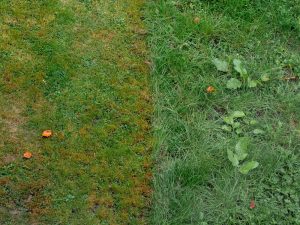 LSU describes centipede decline as large, very yellow or dead patches that appear in spring. Some lawns green up and then die out, and others never come out of dormancy. A patch that stays brown after the rest of the yard wakes up deserves a closer look, not a heavier feeding.
Pale Color on New Growth
The LSU AgCenter notes that iron chlorosis shows up first on new growth. On a centipede lawn, that pale color often points to a pH or phosphorus problem, not a lack of fertilizer.
Rule out water first, though. LSU advises eliminating overwatering and poor drainage as causes before treating soil or adding iron, which is worth remembering on heavy clay after a wet stretch.
Thinning Turf Under Trees
When very few plants or even weeds grow in a shaded spot, LSU says not enough light is reaching the ground. Fallen debris adds to the problem, and LSU lists pine needles, cones, and twigs as lawn waste that sometimes has to be picked up to keep turf in good shape.
Compacted, Discolored Paths
LSU notes that foot traffic compacts soil and stresses centipede, which can show up as purple to red leaves. Ferguson offers a simple check: push a knife into soil that is neither very wet nor very dry. If the blade resists, the lawn may need aeration. LSU adds that compaction forms more quickly on finer-textured soils, which puts clay yards like many in Covington at higher risk.
How Covington Lawn Problems Are Diagnosed and Treated
Good treatment starts with finding the actual cause. Guessing tends to lead to more fertilizer, which Koske warns can push centipede toward decline.
Start With a Soil Test
LSU recommends testing soil through its Soil Testing and Plant Analysis Lab or your parish extension office before amending anything. If pH is too high, sulfur can lower it, but Ferguson advises against applying more than about 8 pounds of sulfur per 1,000 square feet at one time. Sulfur should only go down when a soil test calls for it.
Feed Lightly and Watch the Phosphorus
LSU AgCenter guidance keeps centipede on a light diet, with nutrients beyond nitrogen added only when a soil test calls for them. Our lawn fertilization service is matched to your soil, grass species, and conditions, which on centipede means a light hand.
Adjust Care for Shade
In shaded areas, LSU suggests feeding at lower rates and less often than in full sun, mowing slightly higher, and limiting foot traffic. Water shaded turf deeply and less often, and check it on its own schedule, since tree roots pull moisture from the same soil. Where grass simply will not hold, groundcovers or mulch may be the better answer.
Control Thatch, Compaction, and Tree Debris
LSU recommends dethatching or aeration from late spring to summer. Our lawn aeration service loosens compacted soil and opens channels so air, water, and nutrients reach the roots. For needles and leaves, a good mulching mower can chop debris back into the turf, and our guide on whether to mulch or remove leaves from your lawn covers when bagging makes more sense.
| Treatment | LSU AgCenter Guideline | Best For |
|---|---|---|
| Soil test and sulfur | Sulfur only when a test calls for it, about 8 lb per 1,000 sq ft max at one time | Yellowing tied to high pH |
| Light feeding only | Feed sparingly, guided by a soil test, and skip high-phosphorus all-purpose blends | Healthy centipede in sun |
| Iron chelate spray | Foliar iron for extra green, in place of more nitrogen | Pale color without decline |
| Shade adjustments | Feed less than sunny turf, mow slightly higher, limit traffic | Grass under pines and live oaks |
What This Means for Your Covington Lawn
A healthy Northshore lawn comes from working with the conditions, not against them. That means testing before liming, feeding centipede lightly, mowing it low, and giving shaded areas their own plan.
An extra bag of all-purpose fertilizer or an untested lime application can undo a season of careful mowing. A soil test and a light feeding plan are cheap insurance by comparison.
Many Covington yards also mix full sun near the street with deep shade under the trees. Those two zones can need different mowing heights, watering, and feeding, and a good plan treats them separately.
Our lawn care services in Covington cover mowing, fertilizing, weed control, aeration, and more, with each visit adjusted to local weather and your grass.
At Big Easy Grass Cutting, we would be glad to walk your yard and tell you what we see. To schedule lawn care in Covington, call us at 504-910-7829.
Frequently Asked Questions
Lawn Care vs Lawn Maintenance: What's the Difference?
Lawn maintenance usually means the routine work that keeps a yard tidy, such as mowing, edging, and cleanup. Lawn care is broader and focuses on the health of the grass itself, including fertilizing, weed control, aeration, and fixing problems like thin or yellow turf. On a Covington centipede lawn, the care side is where decisions about color and density get made. Our Covington service covers both.
When to Fertilize Centipede Grass in Louisiana?
The LSU AgCenter recommends feeding centipede only while it is actively growing, between midspring and midsummer, and keeping every application light. For exact timing by grass type, see our month-by-month New Orleans fertilization schedule.
Why Is My Centipede Grass Dying?
The most common causes are overfertilizing, too much phosphorus, heavy thatch, mowing too tall, drought stress, and dense shade. LSU calls the resulting pattern centipedegrass decline, which shows up as large yellow or dead patches in spring. A soil test is the best first step because it rules pH and nutrient problems in or out.
What Does Centipede Grass Look Like?
Centipede is a medium-textured grass with sharply creased, bright green leaves that have a narrow, rounded tip. It spreads by aboveground stems called stolons and sends up slender single seed heads. LSU points out that it can be confused with St. Augustine, but St. Augustine has wide leaves arranged opposite each other, while centipede’s narrower leaves alternate along the stem.
When to Plant Centipede Grass Seed in Louisiana?
The LSU AgCenter says warm-season grasses can be seeded from March to July. Seeding between mid-April and early June is ideal, because soil is warm enough for fast germination and spring rains help establishment. LSU suggests 0.5 to 1 pound of pure live centipede seed per 1,000 square feet, and notes that sod is the most common way centipede lawns are established.
What Are Common Centipede Grass Issues?
The most common issues are centipedegrass decline from overfeeding, heavy thatch, or drought, and yellowing from iron chlorosis when soil pH climbs or phosphorus builds up. Centipede also thins out in heavy shade, and compacted soil along paths can turn its leaves purple to red. Several of these trace back to care habits, so a soil test is a sensible first step before adding any product.
How to Water Centipede Grass?
Water deeply and less often, and only when rainfall falls short. LSU notes that normal rainfall is often enough, but centipede is one of the most drought-sensitive turfgrasses, so dry spells call for irrigation. Keep moisture steady in spring, and stop before water runs off the surface. Deep, less frequent watering encourages roots to grow deeper into the soil, which helps the grass ride out the next dry spell.
Lawn Care vs Landscaping: What's the Difference?
Lawn care focuses on the grass: mowing, feeding, weed control, aeration, and repairing thin turf. Landscaping usually covers the broader design of a yard, including beds, shrubs, trees, and hardscape features. Our work centers on healthy turf, from routine mowing to sod installation and seasonal cleanup.

Related Service
Residential Lawn Mowing
Lawn perfection at your doorstep.
See our Covington service area page