
504-910-7829

Covington sits on the Northshore of Lake Pontchartrain, in a part of St. Tammany Parish that grew up among pine forests and now protects a prized live oak canopy. That shade, acidic soil, and a slow-growing grass that punishes overfeeding are why lawns here fail differently than lawns across the lake.

When a centipede lawn under tall trees starts thinning and turning yellow, the reflex fix of more fertilizer tends to make it worse.

Lawn care in Covington follows different rules than it does on the south shore. Centipede is common here, tree cover shapes nearly every yard, and the soil chemistry pushes back against habits that suit a sunny St. Augustine lawn.

At Big Easy Grass Cutting, we care for lawns across the Northshore, and we put this guide together for Covington homeowners who want grass that holds up under their trees.

If your grass is thinning, yellowing, or refusing to fill in under your trees, contact us and we can take a look before the next growing season.

Below, we break down what makes this area different, what causes centipede grass to struggle, which warning signs matter, and how each problem is treated.

What Makes Lawn Care in Covington Different

Covington has been the seat of St. Tammany Parish since 1829, according to the City of Covington’s history page. The same page notes that the area’s early trails ran through vast virgin pine forests, and that south shore visitors once came here to escape the city’s heat. Trees still define the town, and they shape nearly every lawn decision you make.

Pine and Live Oak Shade

The city’s Tree Board lists care of Covington’s live oak canopy as a special interest. That canopy is beautiful, and it is hard on grass.

The LSU AgCenter notes that trees with spreading branches, such as live oaks, can create extremely shady conditions. Grass growing under a tree gets filtered light, so it grows taller but not denser. Trees and turf also compete for the same soil moisture.

Centipede Grass Country

In her guide to taking care of centipedegrass lawns, Mary Helen Ferguson, an LSU AgCenter extension agent serving Tangipahoa and Washington parishes next door, calls centipede and St. Augustine the two most common turfgrasses in her area. She adds that best practices for the two are different, and care meant for one will not give the best results on the other.

Centipede earned the nickname “lazy man’s grass” because it grows slowly and needs little upkeep. It also tolerates only light shade, while St. Augustine is considered the most shade-tolerant warm-season grass.

Acidic, Heavy Soil

The soil in Covington is mostly clay, and it can be challenging to work with. Ferguson notes that many soils in the Southeast are naturally acidic, and centipede actually prefers that. The LSU AgCenter’s home lawn guide to centipedegrass recommends a soil pH between 5 and 6 for this grass, which is more acidic than most other turfgrasses want.

Plenty of Rain, Uneven Timing

NOAA’s 1991 to 2020 climate normals for the Covington 4 NNW weather station show about 62.5 inches of rain a year. June is the wettest month at roughly 6.7 inches, and November is the driest at about 4 inches. Averages hide the dry stretches between storms, though, and those gaps matter for a grass that dislikes drought.

Common Causes of Thin or Yellow Centipede Grass

LSU AgCenter guidance points to four causes, and they often overlap.

Too Much Fertilizer and Phosphorus

In the LSU AgCenter article Pitfalls of Lazy Man’s Grass, horticulturist Dr. Tom Koske warns that owners can “kill it with kindness.” Centipede needs very little nitrogen, and heavy feeding is linked to excess thatch, iron chlorosis, and a lethal pattern called centipedegrass decline.

Phosphorus is a separate trap. According to LSU, repeated use of all-purpose blends like 8-8-8 and 13-13-13 can build up too much phosphorus and harm centipede lawns. For any nutrient other than nitrogen, Ferguson says a soil test is the only way to know how much, if any, the lawn needs.

Soil pH Drifting Too High

Many Louisiana soils hold enough iron, but that iron becomes unavailable to plants when pH climbs. LSU warns that centipede leaves can yellow when soil goes above pH 7, and that very high phosphorus can trigger iron chlorosis even in a more acidic soil.

That is why liming a centipede lawn by habit can backfire. Lime raises pH, which is the opposite of what this grass wants unless a soil test shows the pH has dropped below 5.

Shade and Tree Competition

Under dense pine or oak cover, centipede declines over time. Leaves stretch toward the light, the canopy thins, and the higher humidity in shade raises disease and insect pressure. When pests do damage, the lack of sun keeps the grass from recovering.

Thatch, Tall Mowing, and Dry Spells

Koske calls thatch very dangerous for centipede, along with a tall mowing height. Drought stress is also implicated in decline, and he describes centipede as one of the most drought-sensitive turfgrasses around. Tall cuts, heavy thatch, and fall nitrogen all make the grass more prone to winter freeze damage.

Mowing height is easy to get wrong. LSU recommends mowing centipede at 1 to 2 inches and never removing more than one-third of the blade at once, and Koske notes it grows well at 1 to 1.5 inches. Ferguson gives a practical example: if you mow at 1 inch, try not to let the grass get taller than 1.5 inches before the next cut.

Warning Signs Your Northshore Lawn Needs Attention

These are the signs worth acting on, and spring is when most of them are easiest to spot.

Yellow or Dead Patches in Spring
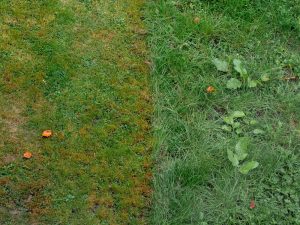
Lawn with a thin, discolored strip of turf beside healthier green grassLSU describes centipede decline as large, very yellow or dead patches that appear in spring. Some lawns green up and then die out, and others never come out of dormancy. A patch that stays brown after the rest of the yard wakes up deserves a closer look, not a heavier feeding.

Pale Color on New Growth

The LSU AgCenter notes that iron chlorosis shows up first on new growth. On a centipede lawn, that pale color often points to a pH or phosphorus problem, not a lack of fertilizer.

Rule out water first, though. LSU advises eliminating overwatering and poor drainage as causes before treating soil or adding iron, which is worth remembering on heavy clay after a wet stretch.

Thinning Turf Under Trees

When very few plants or even weeds grow in a shaded spot, LSU says not enough light is reaching the ground. Fallen debris adds to the problem, and LSU lists pine needles, cones, and twigs as lawn waste that sometimes has to be picked up to keep turf in good shape.

Compacted, Discolored Paths

LSU notes that foot traffic compacts soil and stresses centipede, which can show up as purple to red leaves. Ferguson offers a simple check: push a knife into soil that is neither very wet nor very dry. If the blade resists, the lawn may need aeration. LSU adds that compaction forms more quickly on finer-textured soils, which puts clay yards like many in Covington at higher risk.

How Covington Lawn Problems Are Diagnosed and Treated

Good treatment starts with finding the actual cause. Guessing tends to lead to more fertilizer, which Koske warns can push centipede toward decline.

Start With a Soil Test

LSU recommends testing soil through its Soil Testing and Plant Analysis Lab or your parish extension office before amending anything. If pH is too high, sulfur can lower it, but Ferguson advises against applying more than about 8 pounds of sulfur per 1,000 square feet at one time. Sulfur should only go down when a soil test calls for it.

Feed Lightly and Watch the Phosphorus

LSU AgCenter guidance keeps centipede on a light diet, with nutrients beyond nitrogen added only when a soil test calls for them. Our lawn fertilization service is matched to your soil, grass species, and conditions, which on centipede means a light hand.

Adjust Care for Shade

In shaded areas, LSU suggests feeding at lower rates and less often than in full sun, mowing slightly higher, and limiting foot traffic. Water shaded turf deeply and less often, and check it on its own schedule, since tree roots pull moisture from the same soil. Where grass simply will not hold, groundcovers or mulch may be the better answer.

Control Thatch, Compaction, and Tree Debris

LSU recommends dethatching or aeration from late spring to summer. Our lawn aeration service loosens compacted soil and opens channels so air, water, and nutrients reach the roots. For needles and leaves, a good mulching mower can chop debris back into the turf, and our guide on whether to mulch or remove leaves from your lawn covers when bagging makes more sense.

Treatment LSU AgCenter Guideline Best For
Soil test and sulfur Sulfur only when a test calls for it, about 8 lb per 1,000 sq ft max at one time Yellowing tied to high pH
Light feeding only Feed sparingly, guided by a soil test, and skip high-phosphorus all-purpose blends Healthy centipede in sun
Iron chelate spray Foliar iron for extra green, in place of more nitrogen Pale color without decline
Shade adjustments Feed less than sunny turf, mow slightly higher, limit traffic Grass under pines and live oaks

What This Means for Your Covington Lawn

A healthy Northshore lawn comes from working with the conditions, not against them. That means testing before liming, feeding centipede lightly, mowing it low, and giving shaded areas their own plan.

An extra bag of all-purpose fertilizer or an untested lime application can undo a season of careful mowing. A soil test and a light feeding plan are cheap insurance by comparison.

Many Covington yards also mix full sun near the street with deep shade under the trees. Those two zones can need different mowing heights, watering, and feeding, and a good plan treats them separately.

Our lawn care services in Covington cover mowing, fertilizing, weed control, aeration, and more, with each visit adjusted to local weather and your grass.

At Big Easy Grass Cutting, we would be glad to walk your yard and tell you what we see. To schedule lawn care in Covington, call us at 504-910-7829.
Free Estimate

Request Your Free Estimate

504-910-7829

Kenner sits on flat, low ground between the Mississippi River and Lake Pontchartrain, and the weather station at its airport logs more than 63 inches of rain in a normal year. Add long summers with warm nights, and a St. Augustine lawn here faces fungus, insects and standing water on a cycle that repeats every year.

Lawn care in Kenner is mostly a water problem with heat stacked on top. Rain that falls on the city has little natural path to drain, and the same warm, wet weather that makes St. Augustine grass grow fast also feeds the diseases that thin it out.

That is why a lawn plan written for a drier or cooler place needs adjusting here. Knowing when large patch, gray leaf spot and chinch bugs tend to show up lets you mow, water and feed around them.

At Big Easy Grass Cutting, we care for lawns across Greater New Orleans, and our lawn care service in Kenner is tailored to the grass, the season and the conditions on each property.

If your St. Augustine is thinning, yellowing or holding water after storms, contact us for a free estimate and a second look at what is going on.

Below, we cover what makes Kenner’s conditions different, what goes wrong with St. Augustine grass here, and how each problem gets sorted out.

What Kenner’s Low Ground and Heavy Rain Mean for Your Lawn

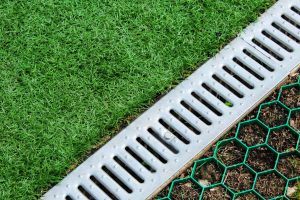
Lawn edge beside a slotted surface drain that carries off heavy rainKenner’s lawns grow on land that works against drainage. Almost every lawn decision here, from mowing height to fertilizer timing, traces back to that fact and to the heat that comes with it.

Flat Land Between the River and the Lake

The Mississippi River forms Kenner’s southern boundary, and Lake Pontchartrain sits to the north. The City of Kenner’s flood and drainage guidance notes that most of Kenner and Jefferson Parish lies at or below sea level, on land prone to subsidence.

The city also explains that this low, flat ground provides little natural gravity drainage. Rainwater has to be moved out through drainage canals and pump stations.

For a lawn, that means water landing in a low corner of the yard can stay there. Louisiana’s extension service warns that low spots hold water and stress grass, and a yard that stays soggy gives fungus the moisture it needs.

More Than 63 Inches of Rain in a Normal Year

Louis Armstrong New Orleans International Airport sits inside Kenner’s city limits, and its weather station anchors the local climate record. The National Weather Service’s 1991 to 2020 climate normals put the airport’s average annual rainfall at 63.35 inches.

June is the wettest month at 7.62 inches, and August follows with 6.91. October is the driest month at 3.70 inches, which is when a sprinkler system is most likely to earn its keep.

The wettest stretch lines up with summer, the main growing season for Louisiana lawns. Soggy soil and fast growth arrive together.

Long, Hot Summers With Warm Nights

The same NWS normals show average highs of 91.4 degrees in July and 91.3 in August at the airport. Average lows in both months stay above 76 degrees, so the grass gets little relief overnight.

Spring and fall carry a different risk. Normal lows run 61.7 degrees in April and 64.3 in October, which puts Kenner’s nights right inside the temperature band where large patch spreads fastest.

Common Causes of Saint Augustine Grass Trouble in Kenner

St. Augustine is a common warm-season lawn grass in Louisiana. LSU AgCenter describes it as well-suited to warm, humid weather, with more shade tolerance than other warm-season grasses. Its weak points line up closely with Kenner’s climate.

Large Patch in Spring and Fall

Large patch, formerly called brown patch, is caused by the soilborne fungus Rhizoctonia solani. According to LSU AgCenter’s large patch fact sheet, it develops fastest when nights run 60 to 75 degrees and days stay below about 85 to 90 degrees.

It also favors lawns hemmed in by trees, shrubs and fences, which slow drying after rain or irrigation. Excess nitrogen makes symptoms worse, and LSU AgCenter notes that St. Augustine is more prone to large patch than some other turfgrasses.

Gray Leaf Spot in Midsummer

Gray leaf spot is a leaf disease caused by the fungus Pyricularia grisea, and it commonly hits St. Augustine. In Louisiana it typically appears from midsummer to early fall.

It thrives in warm, humid weather between 82 and 90 degrees, with long periods of moisture on the leaf from rain, irrigation or morning dew. Drought stress, compacted soil, herbicide use and heavy nitrogen all favor it.

Southern Chinch Bugs in Hot, Dry Spells

The southern chinch bug is primarily a St. Augustine pest. It favors thick thatch, full sun and hot, dry weather, and most injury happens in mid-to-late summer.

In Louisiana, this insect can complete 3 to 4 generations a year. A dry week in a sunny Kenner yard during August is the setup to watch.

Thatch and Compacted Soil

Thatch builds up over time in St. Augustine lawns, and compaction forms faster on fine-textured soils and in high-traffic areas. Thatch shelters chinch bugs and gives the large patch fungus a home. Compaction slows drainage in a yard that already drains poorly.

Warning Signs Your Kenner Lawn Needs Attention

Each problem leaves a different mark on the grass. Reading the mark correctly keeps you from treating the wrong thing.

Yellow-Edged Patches That Pull Loose

Large patch shows up as circular or irregular patches that can grow quite large. On St. Augustine, the leading edge of each patch has a yellowish cast.

The fungus rots the base of the leaf sheath, so leaves pull easily off the stem while the roots stay unaffected. Grass inside the patch looks thin and sunken, and weeds often move in.

Spotted Blades With Tan Centers

Gray leaf spot starts as small, brownish, round to oblong spots on the leaf blades. As it progresses, the spots widen and develop dark brown margins with light tan centers.

In warm, humid weather, clusters of gray spores can appear in the middle of each spot. Infected blades eventually dry out, shrivel and die.

Yellow-Brown Areas in Full Sun

Chinch bug injury turns grass yellow, then brown, and then kills it. The damage starts in scattered patches that can merge into one large dead area, and it tends to follow sun and dry weather.

Water That Sits After a Storm

Puddles that linger in the same spot after every heavy rain point to a drainage or compaction issue. LSU AgCenter’s guidance for both large patch and gray leaf spot calls for improving internal soil drainage, so standing water is a disease warning as well as a nuisance.

It helps to note where puddles form after a downpour and how long they last. That simple record shows whether the problem is one low corner or the whole yard, which shapes the fix.

How Kenner Lawn Problems Are Diagnosed and Managed

Diagnosis starts with the season and the pattern of damage. Management is mostly cultural: mowing, watering, feeding and soil care done at the right height and time. LSU AgCenter treats fungicides and insecticides as a possible addition to those practices, applied strictly by the label.

Problem When It Shows Up in Kenner First Cultural Step
Large patch Spring and fall, when nights run 60 to 75 degrees Water early in the morning, hold nitrogen to label rates, skip mowing wet grass
Gray leaf spot Midsummer to early fall, in humid 82 to 90 degree weather Avoid quick-release nitrogen in summer, water deeply and early
Southern chinch bug Mid-to-late summer, in hot, dry, sunny spots Run a flush test, reduce thatch, water as rainfall requires
Standing water and compaction After heavy rain, in any season Aerate to improve internal drainage and loosen compacted soil

The Flush Test for Chinch Bugs

The extension service’s flush test is simple. Mix 1 tablespoon of lemon-scented soap into 1 gallon of water, then pour it slowly over healthy grass at the edge of the damage.

Drench about 1 square foot in wet conditions or 4 square feet in dry conditions, and watch for 5 to 10 minutes. Its chinch bug guide suggests insecticide treatment when 25 to 30 chinch bugs per square foot come to the surface.

Mowing at the Right Height

LSU AgCenter recommends mowing St. Augustine at 2.5 to 3 inches in sun and 3 to 3.5 inches in shade, never removing more than one-third of the blade at once. The right height helps prevent scalping and weed encroachment.

When disease is active, raise the height to help recovery, skip mowing while blades are wet, and mow infected areas last. Our residential lawn mowing service adjusts cutting height to the grass species, the season and the weather.

Watering and Feeding on a Saint Augustine Schedule

In a normal year, rainfall may carry a St. Augustine lawn, so irrigation is mainly for dry spells. When you do water, go early in the morning, deeply and as infrequently as the grass allows. LSU AgCenter horticulturist Dan Gill notes that lawns need no more than about 1 inch of water a week, even in the hottest part of summer.

For fertilizer, LSU AgCenter suggests 1 pound of actual nitrogen per 1,000 square feet in April and June, with an optional August feeding, and never more than 1 pound per application. Our lawn fertilization program is matched to your soil, grass species and conditions.

Aeration for Drainage and Thatch

LSU AgCenter lists aeration as a way to improve internal soil drainage and reduce compaction, and it recommends dethatching or aerating in late spring to early summer while the grass is actively growing. For a Kenner yard that holds water after storms, lawn aeration is a practical first step.

What This Means for Lawn Care in Kenner

A healthy St. Augustine lawn in Kenner comes from working with the calendar and the ground it grows on, not against them. Watch for large patch when nights cool in spring and fall, for gray leaf spot and chinch bugs in the heat of summer, and for drainage trouble after every big storm.

Acting at the first sign of a patch, a spotted blade or a soggy corner keeps a small problem from spreading across the yard.

At Big Easy Grass Cutting, we mow, feed, aerate and maintain lawns throughout Kenner with a plan tailored to each property.

To set up lawn care for your Kenner home, call us at 504-910-7829 for a free estimate.

Free Estimate

Request Your Free Estimate

Call

Get a Free Estimate

A few details and we will get back to you. Prefer the phone? Call 504-910-7829.