
If you have ever fed your lawn on the first warm weekend of March and watched weeds and brown patches take off, the problem was the calendar, not the bag. Knowing when to fertilize a lawn in New Orleans matters as much as what you spread, because our warm-season grasses only use nitrogen well during a specific window.
That window is well documented. In its April lawn fertilization guidance, the LSU AgCenter recommends fertilizing every warm-season turfgrass grown in Louisiana, including St. Augustine, centipede, bermuda, and zoysia, between April and August. The same guidance warns that nitrogen applied too early or too late can feed weeds, raise the risk of the disease large patch, and leave grass less cold hardy going into winter.
At Big Easy Grass Cutting, we care for lawns across the New Orleans metro, and we build every feeding plan around that seasonal window and the grass actually growing in the yard.
If you would like a fertilization schedule set up for your own lawn this coming spring, contact us and we will walk through it with you.
LSU AgCenter guidance: fertilize Louisiana’s warm-season lawns between April and August, and never apply more than 1 pound of nitrogen per 1,000 square feet in a single application.
When Should You Fertilize a Lawn in New Orleans?
The short answer is mid-April through August, with the exact number of feedings set by your grass type. In south Louisiana, the first feeding belongs in mid-April, and August is usually the last application of the year.
Everything outside that window is either preparation (soil testing and lime in winter) or protection (potassium and disease prevention in fall). Nitrogen, the first number on the bag, is the nutrient the calendar controls.
LSU AgCenter gives the same standard nitrogen rates to every lawn of a given grass type, with or without a soil test, for a simple reason. The forms of nitrogen in most lawn fertilizers do not stay in the soil long. In our climate, they are either taken up by the grass or leached out by rain and irrigation fairly quickly, so nitrogen has to arrive when roots are ready to use it.
The Root and Soil Signals That Set the Calendar
Two signals decide when the season really starts:
- Spring root decline. In early to mid-March, warm-season grasses shed much of their old root system and grow new roots. The blades may be greening up, but the roots underneath are not ready to absorb fertilizer.
- Soil temperature. LSU AgCenter’s Horticulture Connection newsletter for January/February 2026 says to hold nitrogen until soil consistently reaches the upper 60s °F at a 2-inch depth. A simple soil thermometer pushed 2 inches into the lawn tells you where you stand.
Feeding before both signals line up pushes leafy growth at the expense of roots. The lawn then heads into a New Orleans summer with a weaker root system.
It also helps to know that feeding is partly optional. A lawn that has stayed thick and healthy with occasional fertilizer can often skip a year without trouble. The lawns that benefit most are those recovering from damage, those that are thin or low in vigor, and those whose owners want a high level of quality.
Step 1: Test Your Soil in Winter Before You Buy Fertilizer
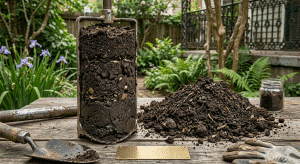 January and February are the months to plan, not feed. A soil test tells you the one thing a bag label cannot: what your soil already has and what it lacks.
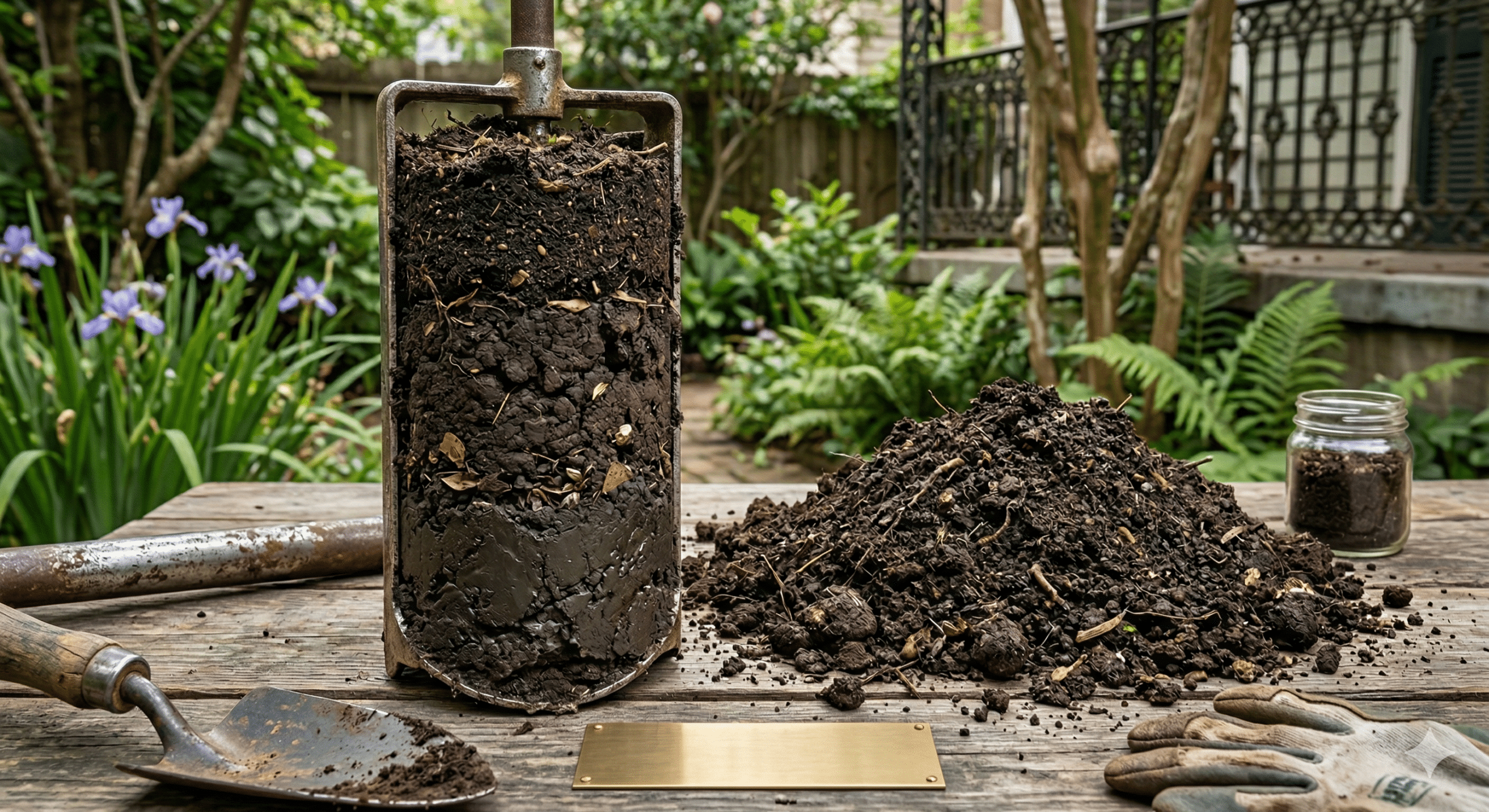
A soil test does not change the nitrogen rates in this schedule, but it covers everything else: pH, phosphorus, and potassium. The LSU AgCenter Soil Testing and Plant Analysis Lab recommends resampling every 2 to 3 years and collecting soil from 15 to 20 spots in a zigzag pattern, mixed in a clean bucket, for each sample. Your parish extension office can supply sample bags, and samples can be mailed straight to the lab in Baton Rouge.
Pay close attention to pH, because our common grasses want different ranges:
- Centipede: pH 5 to 6, more acidic than most grasses prefer
- St. Augustine: pH 6 to 7.5
- Bermuda and zoysia: pH 5.8 to 7.2
If the report calls for lime, apply it in winter. Lime needs months to react with the soil, so put it down well ahead of spring. Our post on how soil type in New Orleans affects lawn health explains why local soils can test so differently from one yard to the next.
Step 2: Identify Your Grass and Measure the Lawn
Every rate in this schedule is written per 1,000 square feet, so you need two numbers before spring: your grass type and your lawn’s square footage.
Grass type changes the whole plan. LSU AgCenter’s April guidance ranks the common Louisiana lawn grasses by nitrogen demand this way:
- Centipede is the lightest feeder, needing about 1 pound of actual nitrogen per 1,000 square feet per year.
- St. Augustine and zoysia need about 2 pounds per year, with an optional third pound in August.
- Bermuda is the heaviest feeder, taking 1 pound in April, June, and August, with extra feedings for hybrid varieties.
To measure, break the lawn into rectangles, multiply length by width for each, and add them up. Leave out beds, the driveway, and the footprint of the house.
Then convert “actual nitrogen” into pounds of product. Divide the nitrogen you want by the first number on the bag, written as a decimal. For 1 pound of nitrogen, that works out to about 6.3 pounds of a 16-0-8 fertilizer (1 divided by 0.16), 10 pounds of 10-10-10 (1 divided by 0.10), or about 3 pounds of 33-0-0 (1 divided by 0.33).
Here is how that works on a real yard. A 5,000-square-foot St. Augustine lawn needs 5 pounds of actual nitrogen per feeding. With 16-0-8, that is about 31.5 pounds of product (6.3 pounds times 5), spread evenly across the whole lawn. Write the number down so June’s feeding uses the same math.
Step 3: Wait Out March and Watch for Full Green-Up
March is the hardest month to be patient. Lawns begin to green up, neighbors start spreading fertilizer, and weed and feed bags fill the garden centers.
Hold off anyway. Nutrients absorbed during early green-up can make lawns more susceptible to spring brown patch, a disease especially common in St. Augustine. Early nitrogen also feeds the winter weeds that are still actively growing.
Use March for other work:
- Mow once the turf greens up naturally. The same newsletter advises waiting for natural green-up before the first mow.
- Treat weeds separately. That newsletter also recommends keeping fertilizer and herbicide applications apart and avoiding weed and feed combination products. If broadleaf weeds are the problem, treat them on their own schedule, and see our weed control service if you want help.
- Check soil temperature weekly. Once readings at 2 inches stay in the upper 60s, the April feeding is close.
Step 4: Make the April Feeding at the Right Rate
Mid-April is the first real fertilizer date of the year in south Louisiana. By then, warm-season grasses have begun active growth and rebuilt a strong root system.
April rates by grass type, in pounds of actual nitrogen per 1,000 square feet:
- St. Augustine: 1 pound, slow-release or readily soluble
- Zoysia: 1 pound, the same as St. Augustine
- Centipede: 1 pound of slow-release nitrogen for the whole year, or 0.5 pound if you use a readily soluble product and split it with June
- Common bermuda: 1 pound
- Hybrid bermuda: 1 pound, followed by another pound in May
Application technique matters as much as the rate. Fertilize a lawn that was recently mowed so granules reach the soil, apply to dry turf, and water it in thoroughly afterward. A drop spreader gives the most even coverage: spread half the product in one direction, then the other half crosswise.
Product choice is less important than people expect. Just about any commercial lawn fertilizer can do the job. Check the label and look for one where one-third to one-half of the nitrogen is slow-release, so the feeding lasts longer.
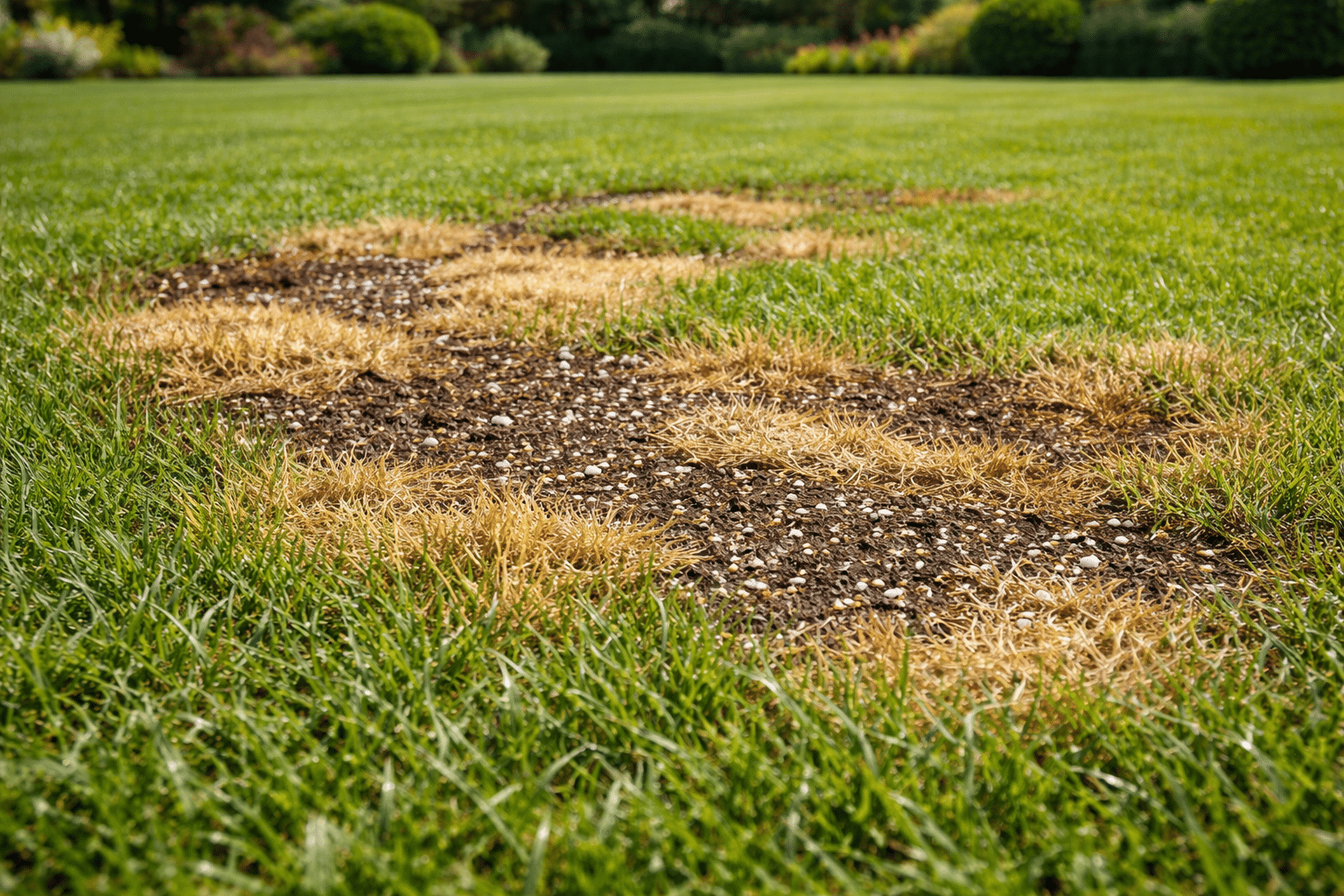
Two limits keep the lawn safe. Never go above 1 pound of nitrogen per 1,000 square feet in a single application, and watch the middle number on the bag. Repeated use of balanced products like 8-8-8 or 13-13-13 can build up phosphorus, which can harm centipede in particular.
If a spreader ever drops too much in one spot, our guide on whether over-fertilizing can damage your grass covers what that looks like and how to respond.
Step 5: Follow Up in June and Decide on August
The April feeding carries the lawn into early summer. June is the second planned feeding for most grasses, and August is the last optional one.
Here is the full year at a glance, based on LSU AgCenter’s published rates in pounds of actual nitrogen per 1,000 square feet.
| Month | St. Augustine and Zoysia | Centipede | Bermuda |
|---|---|---|---|
| January to February | Soil test, lime if the report calls for it | Soil test, sulfur or lime only if the report calls for it | Soil test, lime if the report calls for it |
| March | No fertilizer | No fertilizer | No fertilizer |
| April (mid-month) | 1 lb | 1 lb slow-release, or 0.5 lb soluble | 1 lb |
| May | None | None | Hybrid only: 1 lb |
| June | 1 lb | 0.5 lb, only if you split a soluble product | 1 lb |
| July | None | None | Optional 1 lb for more growth |
| August | Optional 1 lb, last nitrogen of the year | Optional, only to encourage more growth | 1 lb |
| September | No nitrogen | No nitrogen | Hybrid only: optional 0.5 lb in early September |
| October to December | No nitrogen | No nitrogen | No nitrogen |
A few notes on reading the schedule:
- St. Augustine and zoysia get their second pound in June. The August pound is optional, for lawns where you want more growth.
- Centipede needs no June feeding if you used slow-release in April. It is the grass most likely to be overfed.
- Bermuda runs on the fullest calendar, and hybrid varieties add a May feeding plus an optional half pound in early September.
June is also a good time for other summer work. Late spring and early summer are the usual window for aerating or dethatching, while the grass is growing fast enough to recover.
Step 6: Stop Nitrogen After August and Switch to Fall Care
September is where many New Orleans lawns get into trouble. The heat breaks, garden centers stock “winterizer” bags, and it feels like a good time to feed. For St. Augustine, centipede, zoysia, and common bermuda, it is not.
LSU AgCenter’s fall and winter lawn care guidance advises against high-nitrogen fertilizer this late in the season. Nitrogen stimulates fall growth, which keeps the grass from slowing toward dormancy, leaves it more exposed to cold injury, and invites large patch in St. Augustine during our mild fall months.
Large patch thrives in the cool, wet spells of fall and spring. LSU AgCenter’s large patch fact sheet (publication 3624-Y) reports that the disease develops rapidly when nighttime temperatures run 60 to 75 °F and daytime highs stay below 85 to 90 °F, and that excess nitrogen makes symptoms worse.
What you can do in fall:
- Use potassium, not nitrogen. The same fall guidance describes “winterizing” a warm-season lawn as slowing growth and raising potassium. The first number on a winterizer should be zero or very small, and the third number the highest, as in 0-0-60.
- Skip weed and feed. Since it is too late to fertilize, leave combination products on the shelf at this point in the year.
- Plan preemergence weed control by early October. Early October is the recommended window for preventing cool-season weeds like burweed, chickweed, and henbit.
- Water early in the morning. Grass that dries quickly after irrigation is less prone to large patch.
By mid-to-late November or December, most warm-season grasses go fully or partly dormant, though St. Augustine may not fully go dormant in a mild south Louisiana winter. No fertilizer is needed until the next mid-April.
Work With a New Orleans Lawn Team That Keeps Fertilizer on Schedule
A good fertilization schedule is mostly about restraint: testing first, waiting out March, feeding at measured rates from April through August, and switching to potassium once fall arrives. Getting the timing right protects the lawn from weeds, large patch, and winter injury all at once.
The hard part is staying consistent year after year, with the right rate for the right grass in each part of the yard.
At Big Easy Grass Cutting, our lawn fertilization service in New Orleans starts with an analysis of your lawn and a schedule customized to your soil, grass species, and growing conditions.
Want next spring’s feedings planned before March arrives? Call us at 504-910-7829 for a free estimate.